
India must re-negotiate its nuclear deal with the US in order to save its strategic interests, former national security adviser Brajesh Mishra said Tuesday night.
Terming the Indo-US civilian nuclear deal as "unique to India and not a model to replicate", a senior Bush administration official said the United States is committed to cooperate with Pakistan in enhancing its energy needs but "a civilian nuclear deal with it was not on the table".
With most United Progressive Alliance constituents disfavouring early polls, Congress on Friday said it wants to take the Left allies along while pushing the Indo-US nuclear deal and that there would be "no loss of face" if the agreement fails.
The Left, as also several other parties, have been expressing apprehensions over various aspects of the deal and have been demanding that the sense of Parliament be taken into consideration and had contended that the government had no majority on the issue.
External Affairs Minister Pranab Mukherjee on Sunday night said the government was confident of addressing the Left concerns on issues of national interest, including the Indo-US civil nuclear deal.
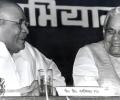
'He told senior journalists a few days after the Babri Masjid demolition, 'Jo hua theek hua. Maine isliye hone diya ki BJP ki rajniti hamesha ke liye khatam ho jaye.'

The CPI-M leader was fluent in Hindi, Telugu, Tamil, Bangla, and also Malayalam. He was also well-versed in Hindu mythology, and often used those references in his speeches especially to attack the BJP.
The 10-member ASEAN described the Indo-US nuclear deal as an extremely positive step, hoping that the two countries would be able to conclude the pact soon.
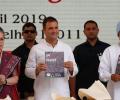
'Mrs Gandhi had nothing to do in the day-to-day working of Dr Singh's government.' 'People say Mrs Gandhi's office used to give orders, which is nonsense.'
The supporting parties bluntly rejected Prime Minister Manmohan Singh's suggestion that India should not miss the bus of nuclear renaissance as they insisted that "the destination of the bus will be the stranglehold of the United States."
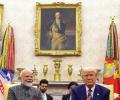
'Modi's intention was to create goodwill that will allow India to be seen by Trump as more than just a bad tariff problem.' 'He succeeded brilliantly on that count but none of these wins are unfortunately permanent.' 'Modi will have to do this again and again if Trump's grievances are to be durably assuaged.'
Areva, the French nuclear group, agreed on Wednesday to supply India with up to six nuclear reactors in one of the first deals since the subcontinent's nuclear programme was brought into the international fold last year after decades of isolation.
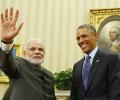
With their landmark 2005 civil nuclear deal still in limbo, India and the United States have established an inter-agency contact group to sort out outstanding liability and technical issues to fast-track its full implementation.
Maintaining its strident opposition to the historic Indo-US civilian nuclear deal, the Chinese state media has accused Washington of contradicting its obligations under the Non-Proliferation Treaty.
The much-debated Nuclear Liability Bill, crucial for operationalising the India-US civil nuclear deal, would be tabled in the Rajya Sabha on March 15, Minister of State for Atomic Energy Prithviraj Chavan has said.
The special cell of the Delhi police, which had earlier arrested the accused Mukesh Saini along with system analyast Shib Shankar Paul, alleged the latter had developed "intimate" and "close relationship" with the American diplomat Rosana Minschew to whom the secrets were passed on.
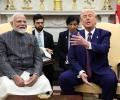
'Trump administration wanted a positive tone at this summit, but there was still some anxiety that there could be some awkward moments -- and there were not.'
Rejecting some critics' argument as to what message the US was sending to Iran by signing a nuclear energy deal with India, Burns said, "We don't see the connection between what Iran is doing and what India seeks to do."
For future growth, India also required to enhance its growth in accelerator development and on hydrogen economy and all these need development of science of cryogenics, he said.
US committed to implementing Indo-US nuclear deal: Burns
People's Daily, the mouthpiece of the ruling Communist Party of China, on Monday described Indo-US nuclear deal a "major blow" to non-proliferation, apparently reflecting the Chinese government's thinking on the issue.

The government has approved the construction of two indigenously designed nuclear attack submarines and is expected to ink contracts next month to procure 26 naval variant of Rafale jets and three Scorpene submarines, Navy Chief Admiral Dinesh Tripathi said on Monday.
The sources said evolving public opinion in favour of the agreement would not be difficult in France, unlike that of the US.
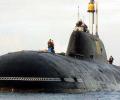
China on Tuesday angrily denounced the nuclear-powered submarine deal announced by the US, UK and Australia, saying the pact violates the Non-Proliferation Treaty (NPT) and the three countries are travelling "further down the dangerous and wrong path."
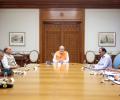
'The government has to explain (to the army, air force and navy chiefs) whether they want a punitive strike, a deep punitive strike, or whether they want limited war or an all-out war, will it be a circumscribed war or will it be a shallow attack along the border.'
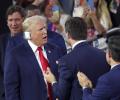
Indian-American Republican leader Nikky Haley has endorsed her former boss Donald Trump as the party's candidate for the presidential election, delivering the message of unity after their bitter rivalry during the presidential primary.
Dr Kakodkar made light of the suggestion that the NSG would meet only in April 2007, which could possibly impact the deal.
'The nation, at this critical juncture, depends on its representatives in Parliament to ensure that decisions taken today do not inhibit our future ability to develop and pursue nuclear technologies for the benefit of the nation'
The tough terms and conditions for the civilian nuclear engagement with India as laid out in the Henry Hyde Act passed by US Congress in December 2006 and intent of the July 18, 2005 statement are at complete divergence with each other and so it is
Ahead of his visit, Burns said, "My trip to New Delhi is to focus on agreement on a timetable that will lead to decisions in the US Congress to change our law and ultimate decision of the Indian Government to meet their commitments."
Administration sources said they are confident that the Bill will be cleared on Thursday.
CPM general-secretary Prakash Karat had said that the government would have to face serious consequences if it went ahead with the nuclear deal.
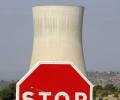
Signalling the continuity of policy, the new government has ratified the Additional Protocol, a commitment given under Indo-US nuclear deal by the previous dispensation to grant greater ease to International Atomic Energy Agency to monitor India's civilian atomic programme.
The Indo-US civilian nuclear deal and the go-ahead for atomic commerce obtained by India from the NSG will help address world's shared interests in energy security and climate change, Minister for External Affairs Pranab Mukherjee said on Tuesday.
